Printed
- Newspaper
FISH INTERNATIONAL (Dezember 1995,
page
54-57)
Farming Installations
Demand for fish is increasing worldwide but raw materials are becoming scarcer and
scarcer. With respect to this, aquaculture is a young, innovative branch of industry with
high growth rates and a secure outlook. The future of the aquaculture sector lies in the
techniques developed to use water resources as saringly as possible and dispose of wast
products in an environment-friendly manner, while at the same time keeping energy
consumption at a minimum.

Aquaculture
Technology is the name of an Austrian company which develops innovative
technology for use within fish production, as well as offering various services in the
field of water management, fish plant planning and management - for both fresh and
salt-water species.
The one hundred per cent subsidiary "Satzfischzucht Hochleithner" runs
three fish farming facilities for the production of fish for stocking purposes, mainly od
species which are difficult to raise: Arctic char, sea trout, grayling, pike, pike-perch,
burbot, sturgeon and others. These are exported to buyers in Germany, Italy, France and
elsewhere.
Closed circuit installations:
Fish production within a closed circuit enables a high level of fish concentration within
a given space, low proportional wage costs and high returns. The wastwater, which suffers
organic contamination from products resulting from the fish's metabolism, is treated using
biological and physical cleaning methods so that 90 per cent of it can be re-used.
Selectice improvement of the water circulation and filter technology has enabled Aquaculture
Technology to offer their customs an efficient, simple, low-cost system for
fresh and salt water. To enable risk minimization, process stability and fish's general
good health, the closed circuit installations are allways constructed in modules, with
each module operating autonomously so that its water supply is seperate from that of other
modules. The modules are are available as from an annual production capacity of two
tonnes, equivalent to a fish stocks of 400 kilograms, and they consist of four round tanks
with a diameter of two meters, one round tank with a diameter of four meters and the
appropriate technology. Once the larger waste particles have been remove dusing an eddy
flow scrubber, the wast-water from the tanks enters a biofilter. The carpet of bacteria
necessary for the nitrification process is attached to the reactor packing; excess sludge
is disloged by current. With 900 square meters per cubic metre of Siporax filter material,
the Aquaculture Technology bioreactors have a
large growth area so that relative small filtering units are sufficient. By blowing in air
via a specially developed ventilation system, no pumps are required, say the company
experts, a feature which leads to energy savings.
Circular current tanks:
The Austrian company's circular tanks are made of dark green or pale blue glass fibre
reinforced polyester resin. The inner surface is absolute smoot. The special conical shape
- inside heights 600 mm at the edge, 700 mm in the middle - and the tapered base with a
funnel-shaped outlet in the middle means that the tank system practically cleans itself.
The system is thus well-suited to keep sensitive ground species as well as raising
juveniles. The drainage system consists of PVC pipes with a diameter of 70 millimeters and
is fitted with a water-level regulator. It can be swivelled twice at an angle of 90
degrees. The edge of the tank is reinforced, enabling the attachment of automatic feeding
and other facilities. The three laminated feet can be adjusted in height so that the tank
will always be stable, Its light weight - about 70 kilograms - means that it can be
adjusted or transported at any time. Aquaculture Technology
supplies the tank in two different sizes: with an inner diameter of two or four
metre. A divided lid and various upright and ground sieves are available as acessories.
Injection aeration:
Aquaculture Technology's tried, tested and
patented injector aerators are also suitable for large ponds. They are powered by a
service-free underwater motor, designed for continous operation and 180 degrees rotatable
with two different performance levels - 0.8 or 1.2 h.p. - and with 220 or 380 volts. The
attached propeller generates a current which can be adjusted as required in any direction.
Surface air is sucked in, atomized and distributed. The current aerates and propels the
low-oxygen water, enabling maximum oxygen enrichment. Because decomposition porcesses on
the pond bed usually lead to oxygen deficit, the system operates on an infinitely variable
basisto a depth of 15 meters, bearing oxygen to the areas where it is needed. The
introduction of exactly dosed pure oxygen is possible in submerged operation, too.
Independent of the installation, depth and the resulting current, the bed can be cleaned
of sediments, too. If the water is to be degassed or surface kept free of ice during the
winter, the aerator should be positioned near the surface. All variations are possible.
Automatic feeders:
In cooperation with the Institute for Fish Research in Innsbruck, Aquaculture
Technology designed a new automatic plankton feeder for the professionally
controlled administration of frozen zooplankton. Zooplankton serves as initial feed for
the production of high-value fish stocks of such species as Arctic char, salmon, grayling,
sturgeon, cod, bass, gilt head bream, halibut and numerous others.The feeding technique is
based on an electronic process, which "washes" the plankton layers off
larger-sized frozen pieces of feed and distributes the rations evenly via a specially
designed, self-cleaning system into the hatching tanks. The "washing" and
defrosting of th eplankton layers is archieved by spraying of flooding, the remaining
plankton is immediately re-fozen. The size of the plankton particles can be adjusted and
controlled via a special sieve unit. In order to avoid the crushing of the defrosted
plankton,distribution to the hatching tanks is carried out along water currents in pipes.
FISH FARMER (July/August 2000,
page
49-50)
Submersible has automatic
underwater feeder
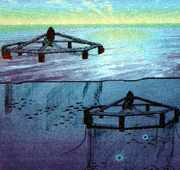 WELL-KNOWN for its pontoon cage
systems, Aquaculture Technology, based in Kitzbühel, Austria offers a wide range
of stock management, fishlarval rearing and production equipment. One of its most recent
developments is an ingenious submersible netcage for offshore locations. The nine-sided
structur, with an axial diameter of ~20 m, has service platforms, passage walkways with
railings and removable hand-ropes. It houses ballast tanks and compressed air cylinders,
permanent buoyancy compartments, balancing tanks and compensation tanks of residual
buoyancy tio allow for discharge of changing loads. Hot galvanized coating provides an
expected service life of more than 20 years. It is reliable, practically excluding
restoration and repair, report the company. Automatic underwater feed distribution is a
feature of the system, designed to store and distribute measured quantities of feed over
periods of 7-30 days. It consist of a cylindrical-conic watertight hopper of 3,000 litre
capacity - holding 2 tons of feed on average - and an automatic feed distributor with a
volumetric type dosage. The feeder houses selenoid vaklves, a system controller and
batteries. Construction is of corrosion-proofed steel (6-8 mm thickness) and non-ferrous
metals. To submerge and surface the cage it is equipped with ballast compartments filled
by gravity via drain holes equipped with valves operated by remote-control pneumatic
drive. Water in the ballast compartments is displaced by compressed air from th eservice
boat compressor. The process of raising and lowering is supervised by the depth sensor,
which has a display located either in the service boat or on-shore via a water acoustic
communication channel. Flexible pipelines and electricity cables come from the signal buoy
to the cage to supply compressed air and power. The net chamber, with a volume of 1,000 to
2,000 cu. m is located in the steel structure on guy ropes running up and down from the
platform. Waste removal is organised with a tray device, liftes to the surface by means of
winches. It is possible to position the cage system in a depth range of 4-40 m, and when
floating, the makers say it will withstand waves up to 6 m and conditions up to Force 6.
Submerged, it can take weather up Force 9 and waves of 8-9 m. Aquaculture
Technology say the cage structure is produced to the "Rules for
Building and Classing Underwater Vehicles, Systems and Hyperbaric Facilities". It
will have the certificate of the official "Maritime Register of Shipping". WELL-KNOWN for its pontoon cage
systems, Aquaculture Technology, based in Kitzbühel, Austria offers a wide range
of stock management, fishlarval rearing and production equipment. One of its most recent
developments is an ingenious submersible netcage for offshore locations. The nine-sided
structur, with an axial diameter of ~20 m, has service platforms, passage walkways with
railings and removable hand-ropes. It houses ballast tanks and compressed air cylinders,
permanent buoyancy compartments, balancing tanks and compensation tanks of residual
buoyancy tio allow for discharge of changing loads. Hot galvanized coating provides an
expected service life of more than 20 years. It is reliable, practically excluding
restoration and repair, report the company. Automatic underwater feed distribution is a
feature of the system, designed to store and distribute measured quantities of feed over
periods of 7-30 days. It consist of a cylindrical-conic watertight hopper of 3,000 litre
capacity - holding 2 tons of feed on average - and an automatic feed distributor with a
volumetric type dosage. The feeder houses selenoid vaklves, a system controller and
batteries. Construction is of corrosion-proofed steel (6-8 mm thickness) and non-ferrous
metals. To submerge and surface the cage it is equipped with ballast compartments filled
by gravity via drain holes equipped with valves operated by remote-control pneumatic
drive. Water in the ballast compartments is displaced by compressed air from th eservice
boat compressor. The process of raising and lowering is supervised by the depth sensor,
which has a display located either in the service boat or on-shore via a water acoustic
communication channel. Flexible pipelines and electricity cables come from the signal buoy
to the cage to supply compressed air and power. The net chamber, with a volume of 1,000 to
2,000 cu. m is located in the steel structure on guy ropes running up and down from the
platform. Waste removal is organised with a tray device, liftes to the surface by means of
winches. It is possible to position the cage system in a depth range of 4-40 m, and when
floating, the makers say it will withstand waves up to 6 m and conditions up to Force 6.
Submerged, it can take weather up Force 9 and waves of 8-9 m. Aquaculture
Technology say the cage structure is produced to the "Rules for
Building and Classing Underwater Vehicles, Systems and Hyperbaric Facilities". It
will have the certificate of the official "Maritime Register of Shipping".
ARAB WORLD AGRIBUSINESS (August 2006,
page 11)
Aquaculture technology, fish
farming & equipment - quality for reasonable prices!
Aquaculture
Technology is the name of an Austrian based company which develops
and exports innovative technology for use within fish production, as well as offering
various services and consulting in the field of water management, fish farm planning and
management - for both fresh- and salt-water species.
AquaTech offers an approved range of products for:
breeding (hatching jars, vertical incubators, breeding troughs), holding (filter systems,
water conditioners, holding basins) feeding (solar, clockwork, pendulum feeders), aerating
(injectors, blowers, diffusers) controlling (meters, scales, pumps), catching (nets,
traps, electro-fishers), transporting (sorters, lifts, tanks), processing (scaling,
skinning, filleting machines) and others (pontoons, motors, boats) and much more (books,
feeds, hormones). To view the huge range of products, the best would be to visit the
extensive website at www.aqua-tech.eu
The one hundred per cent subsidiary "Satzfischzucht
Hochleithner" runs three fish farming facilities for the production of fish maily for
stocking purposes, of species which are usually difficult to raise, like: Arctic charr
(Salvelinus alpinus), Lake trout (Salmo trutta lacustris), Grayling (Thymallus thymallus),
Pike (Esox lucius), Pike-perch (Sander lucioperca), Catfish (Silurus glanis), Burbot (Lota
lota), Sturgeons (Acipenser baerii, Acipenser gueldenstaedtii, Huso huso etc.), and other
species. These are exported as eggs, larvae, fry or fingerlings to buyers mainly in Europe but also elsewhere around the world.
HATCHERY INTERNATIONAL (July/August 2017,
page 28)
First out-of-season reproduction of beluga sturgeon
The Beluga sturgeon (Huso
huso Linnaeus, 1758) has a decreasing
population trend and is classified as critically endangered in the Black-
and Azov seas, and regionally extinct in the Adriatic Sea. It is extirpated
from the upper parts of almost all the European spawning rivers (e.g. Danube,
Dniester, Dnieper, Don, Kuban, Terek and Volga) mainly because of
overfishing and dams that block migration routes.
Depleted fishery
Official commercial landings (mainly Russian)
have decreased dramatically during recent decades, from >520 t/a in the
early 1990’s to <3 t/a at the beginning of the 2010’s. Huso
huso is the largest freshwater fish in the
world, and is a valuable candidate for aquaculture as it has the fastest
growth within the family, and its caviar commands the highest price.
Martin Hochleithner (owner of AquaTech, in
Kitzbuehel, Austria) started farming sturgeon in the mid 1980s, first with
bester (a hybrid of Huso
huso and sterlet, Acipenser
ruthenus), and later with pure-bred
sterlet, Siberian sturgeon (A. baerii), Russian
sturgeon (A. gueldenstaedtii), and
Adriatic sturgeon (A. naccarii).
Early days
In the early 1990s a large number of fertilized H.
huso eggs from the Pontic Danube stock was
hatched and cultured in Austria. These F1 larvae were fed with
live zooplankton (Daphnia)
and choppped live oligochaetes (Tubifex)
for the first weeks. After a month, the fry were weaned onto crumbled
dry-food, mixed with moist feed for a few weeks, then stocked into 5m Ø
circular tanks for five years, until a heavy bacterial infection occurred.
Thereafter the fish were stocked into small earthen ponds (100-2000 m2),
for an additional five years.
Under a cooperation contract with Stefano
Marturano (manager of Azienda Agricola Pisani Dossi in Cisliano, Italy) part
of the 10-year-old sub-adult stock was transferred to Italy (the rest
remained in Austria), in order to divide the risk for these highly valuable
broodstock specimens. There the fish are kept in circular tanks (6m Ø)
supplied with ground-water (at about 12-18 °C), and are fed ad libitum with
pelleted dry-food.
Slow to mature
Under these culture
conditions, the first males matured at nine years of age, but females did
not mature before the age of 18. The first maturing females were found in
the over-ripe stage VI in spring. Later it was discovered that beluga
broodfish in culture conditions get ready for reproduction (stage V) in
northern Italy in autumn (October-December), rather than in spring
(March-May) like wild stocks under natural conditions. Out-of-season
reproduction is reported here for the first time.
Full circle beluga
Full circle cultivation of beluga was reached at
the end of last year, where a new generation (F2) of H.
huso was successfully produced in
captivity. The hatched larvae have been split (50:50) and sent to two
different farms (in Italy and Austria), where they are stocked in different
tanks (large rectangular and small square), and supplied with water at
different temperatures (13-14 and 17-18 °C), and fed with different diets (frozen
chironomids and live zooplankton), and finally weaned onto crumbled
dry-food.
The survival
rates after two months were almost identical, but growth was significantly
faster in the warmer water. A small number of these out-of-season offspring
were supplied for a restocking project in the Italian Po River and another
larger number for farming activities in the European Union.
Breeding
beluga sturgeon in captivity is still far from being routine, but the
outlook is promising. The main problems have been solved, and the minor
troubles identified, so regular reproduction can be expected henceforward.
However, cannibalistic behaviour by the larvae remains an important issue to
solve.
For more information contact Martin Hochleithner by email at: aquatech@a1.net
More Reports in:
Fish Farming International, Northern Aquaculture, Hatchery Magazine, Aqua Revue, Aqua
Noticias, Infofish International, Magazyn Przemyslu Rybnego, Fisch Magazin, Österreichs
Fischerei, etc. |
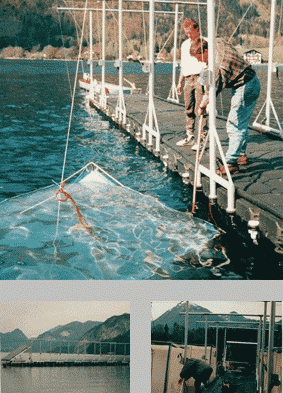 The new UWG-Solar Cagesystem from Aquaculture
Technology is the result of years of tests in sea and freshwater.
The new UWG-Solar Cagesystem from Aquaculture
Technology is the result of years of tests in sea and freshwater. 
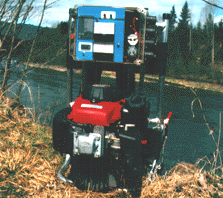 Safe and powerful electric fishing devices are already
being used worldwide with successful results. In various and sometimes problematic areas
of use, a wide range of devices was developed which will match nearly any requirements.
Safe and powerful electric fishing devices are already
being used worldwide with successful results. In various and sometimes problematic areas
of use, a wide range of devices was developed which will match nearly any requirements.
