|
BRINE SHRIMPS as live
larval died
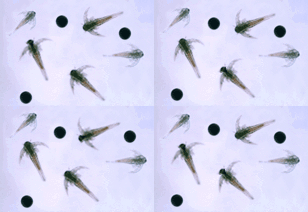 Brine
Shrimp Eggs are the dormancy-eggs (cysts) of Artemia salina, a kind of
miniature shrimp (crustacea) which distribute widely and bear high sale. At
present more than 500 Artemia producing areas in the world are known (such
as America, China, Iran and Russia). It's cysts may be conserved very long,
and can be hatched as they are needed. The naupli hatch after 18-30 hours in
warm (24-30 degree C) salt water (1.5-3.5 % salt), and possess abundant
protein and fat. Its grown-body hold high nourishment, so Artemia is an
excellent food for various fish and crustaceans. Nutrition Analysis: Protein
min. 45 %, Fat min. 15 %, Ash min. 6 %, Fiber max. 2 %, Moisture max. 8 %.
They are available as "Premium Quality" in 425 gram (15 oz.) cans (Net
Weight), and 12 cans per case. Brine
Shrimp Eggs are the dormancy-eggs (cysts) of Artemia salina, a kind of
miniature shrimp (crustacea) which distribute widely and bear high sale. At
present more than 500 Artemia producing areas in the world are known (such
as America, China, Iran and Russia). It's cysts may be conserved very long,
and can be hatched as they are needed. The naupli hatch after 18-30 hours in
warm (24-30 degree C) salt water (1.5-3.5 % salt), and possess abundant
protein and fat. Its grown-body hold high nourishment, so Artemia is an
excellent food for various fish and crustaceans. Nutrition Analysis: Protein
min. 45 %, Fat min. 15 %, Ash min. 6 %, Fiber max. 2 %, Moisture max. 8 %.
They are available as "Premium Quality" in 425 gram (15 oz.) cans (Net
Weight), and 12 cans per case.
Artemia is generally used for feeding the larval and postlarval stages
of shrimps and fishes. The larvae of several species of marine fish, e.g.,
bass, bream, grouper, and turbot, can only be offered an Artemia diet after
an initial period on a smaller prey, primarily the rotifer. In contrast to
crustacean larvae, marine fish larvae are cultured on Artemia for a much
longer period of time (e.g.: 20-40 days). Artemia cyst consumption is also
among the highest in marine fish larviculture and ranges from 200 to 500 g
per 1000 fry produced. Survival, vigor and pigmentation were reported to
be significantly improved in several fish species.
|
Grad-Type: |
1-A Gold |
2-B Silver |
3-C Bronze |
|
Hatching rate min. (%) |
90 |
80 |
70 |
|
Purity min. (%) |
99 |
98 |
97 |
|
Moisture max. (%) |
6 |
7 |
8 |
|
Nauplii per gram |
230,000 |
200,000 |
180,000 |
| Cysts
per gram |
240,000 to 320,000 |
| Cysts
size (µm) |
200 to 250 |
|
Nauplii length (µm) |
460 to 480 |
We deliver also frozen zooplankton as natural fry feed for all fish species! |

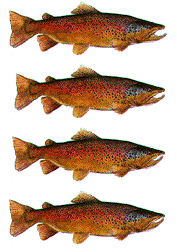
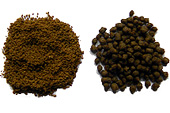 This
specially formulated and extruded dry feed with a reddish-brown color has a
well balanced fatty acid profile and promotes good appetite, fast growth,
high survival and fish health. The extruded feeds are based on raw material
of superior quality and are formulated as a starter and grower feed
specially in closed water or recirculation systems, with minimal phosphate
content and low nitrogen excretion. The particle sizes are also very stable
in the water and hardly pollute it. The feed is highly energetic which
guarantee very low feed conversion rates. It can be used from the first day
on or as a replacement feed of brine shrimp and zooplankton "artificial
plankton". It is suitable for the production of various fish species such as
Salmonids, Percids, Acipenserids, Cyprinids and other species too. On
request, larger pellets (6 or 20 mm), pigmented pellets (Astaxanthin 60
mg/kg) or floating pellets (2-4 mm) are available. It is available in 10
resp. 25 kg bags, at the following types and sizes.
This
specially formulated and extruded dry feed with a reddish-brown color has a
well balanced fatty acid profile and promotes good appetite, fast growth,
high survival and fish health. The extruded feeds are based on raw material
of superior quality and are formulated as a starter and grower feed
specially in closed water or recirculation systems, with minimal phosphate
content and low nitrogen excretion. The particle sizes are also very stable
in the water and hardly pollute it. The feed is highly energetic which
guarantee very low feed conversion rates. It can be used from the first day
on or as a replacement feed of brine shrimp and zooplankton "artificial
plankton". It is suitable for the production of various fish species such as
Salmonids, Percids, Acipenserids, Cyprinids and other species too. On
request, larger pellets (6 or 20 mm), pigmented pellets (Astaxanthin 60
mg/kg) or floating pellets (2-4 mm) are available. It is available in 10
resp. 25 kg bags, at the following types and sizes.