AquaTech
Bookshop
Books and
more ...
|
|
| Acipenseriformes |
|
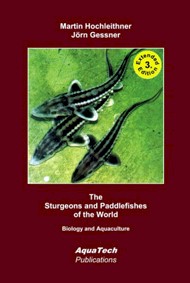
THE STURGEONS AND PADDLEFISHES (Acipenseriformes) OF THE WORLD:
Biology and Aquaculture The breeding and culture of
sturgeons in captivity has advanced rapidly over the past several years. With
recent developments, the requirements of the industry have changed, and the
techniques used have also evolved and been adapted to meet these changing
needs. Based on experience gained in the the former
The BIBLIOGRAPHY of Acipenseriformes: With over 10000 references This bibliography, which includes nearly all publications from around the world, and covers all Acipenseriforms and a range of topics, is intended to serve as a ready reference for researchers, fisheries managers, aquaculturists and conservationists who work with this ancient fish group. The numerous references are listed alphabetically by author(s) and chronologically by year(s), as the original title. Almost all sturgeon- and paddlefish species are threatened or endangered. Information on them is by no means complete, whether in fields related to sturgeon culture, biology, ecology or management. Due to the current rate of wild-stock exploitation and environmental degradiation, the availability of new information might prove crucial for their survival. This is an attempt to disseminate information about work carried out to date, and to increase its availability. The BIBLIOGRAPHY of
Acipenseriformes: Update of the 2000's This bibliography, which covers all Acipenseriforms and a range of topics, is intended to serve as a ready reference for researchers, fisheries managers, aquaculturists and conservationists who work with this ancient fish group. Almost all sturgeon- and paddlefish species are threatened or endangered. Information on them in any field is by no means complete, whether related to sturgeon culture, biology, ecology or management. In many aspects sturgeon biology is very different from that of other fishes, and techniques suitable for other species may not work with them. Due to the current rate of wild-stock exploitation, the availability of new information might prove crucial for their survival. This is an attempt to disseminate information about work carried out to date, and to increase its availability. This is the most important and comprehensive bibliography about Acipenseriformes, and includes nearly all publications from around the world. The references are listed alphabetically by author(s) and chronologically by year(s). This update includes the years 2000-2009. The update is allready included in the bibliography on CD-ROM.
Biology and Conservation of the European Sturgeon
Acipenser sturio L. 1758: The
Reunion of the European and Atlantic Sturgeons
The Siberian Sturgeon (Acipenser baerii
Brandt, 1869) This two-volume book set
focuses on the Siberian sturgeon. Acipenser
baerii one of the "still existing” sturgeon
species, is a native species of the Siberian catchments, where – as in many
other parts of the world – the sturgeon populations are now threatened.
Sturgeon farming practices targeting caviar and meat production have been
expanding worldwide since the 1990s, and have seen a further increase since
the turn of the century. Among the handful of sturgeon species used for
significant production, the most dominant is the Siberian sturgeon. Given
its peculiar phylogenetic position as a chondrostei and its use as a
biological model in some countries, the species has also attracted the
attention of biologists.
Rescue of Sturgeon Species in the Ural River Basin This volume is devoted to the uniqueness, history and problems of the Ural river basin, its sturgeons and perspectives of their conservation. The Ural river, the third longest river in Europe, is a unique ecosystem. Unlike other large European rivers the river has not been regulated and the natural hydrological regime is still intact. Thanks to that it has the only remaining spawning habitats in the entire Caspian basin for all sturgeon species. Nevertheless, this fact is not well known to the broader scientific and environmental communities. The Ural river is also an interesting place due to its rich history of sustainable use of aquatic resources in general and sturgeons in particular. The traditional life style of the local communities, Ural Cossacks, was focused on the preservation and rational use of sturgeon species. This interesting experience of sustainable river-related management is not adequately reported in literature. To secure further Ural sturgeon preservation the river basin ecosystem and human activities in the region must be managed in an integrated sustainable manner. The sturgeon species can be used as a natural indicator and an incentive for such transboundary IWRM cooperation taking into account all three components of sustainable development: economic, social and environmental.
Biology, Conservation and Sustainable Development of Sturgeons Sturgeons are considered “living fossils”, sharing many morphological and biological features with ancestral fish. Furthermore, sturgeons are of the utmost interest from an economic perspective, not only for the caviar but for the flesh. However, the wild populations of the majority of the species are at serious risk of extinction all over the world. So, it is urgent to develop strategies for both farming culture and conservation and recovery in natural habitats. This book provides a comprehensive view of the biology and sustainable development of sturgeons putting emphasis on the Southern Europe autochthonous species such as Acipenser nacarii and Acipenser sturio that share geographical distribution. Other relevant species (such as Huso huso, A. oxyrhinchus, A. ruthenus, A. stellatus) and areas (Germany, Russia, North America) are also considered. The contents are organised in three sections: Taxonomy and Biogeography (including the morphological and genetic analyses that clarify the taxonomy and phylogeny of sturgeons), Biology and Aquaculture (where several aspects of the developmental biology, feeding, and reproduction are considered in relation to the improvement of sturgeon farming), and Recovery and Conservation (that collates and analyses different recovery research actions, the ecology of the rivers for restoration as well as the problems related to the trade of caviar).
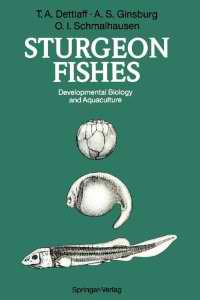
Sturgeon Fishes: Developmental Biology and Aquaculture This book is the first detailed description of the embryonic development of all important Russian sturgeon species - from the egg, over the various larval stages to the grown up fish. Besides dealing with the typical issues of developmental biology: hormonal stimulation of oocyte maturation; development of the mature egg organisation and the role of the ucleus and the cytoplasm in this process; timing of the mitotic phases; changes in the cell cycle during the transition to gastrulation; morphometric movements during the gastrulation. Emphasis is also placed on fish breeding in aquaculture, with special recommendations and instructions for the artificial breeding of sturgeons. This is a reprint of the original edition from 1993.
Sturgeons and Paddlefish of North America
Contents: Inga Saffron - Introduction: The Decline of the North American Species; Tim E. Holzkamm and Leo G. Waisberg - Native American Utilization of Sturgeon; Jennifer A. Wilson and R. Scott McKinley - Distribution, Habitat, and Movements; Joseph J. Cech Jr. and Serge I. Doroshov - Environmental Requirements, Preferences, and Tolerance Limits of North American Sturgeons; Michael J. Miller - The Ecology and Functional Morphology of Feeding of North American Sturgeon and Paddlefish; Paul Vecsei and Douglas Peterson - Sturgeon Ecomorphology: A Descriptive Approach; Jessica A. Bolker - Embryology; Stephan J. Peake - Swimming and Respiration; Thomas D. Singer and James S. Ballantyne - Sturgeon and Paddlefish Metabolism; Greg T. O. LeBreton and F. William H. Beamish - Growth, Bioenergetics and Age; Michael R. Robinson and Moira M. Ferguson - Genetics of North American Acipenseriformes; Nancy J. Léonard, William W. Taylor, and Christopher Goddard - Multijurisdictional Management of Lake Sturgeon in the Great Lakes and St. Lawrence River; Nancy A. Auer - Conservation; Joel P. Van Eenennaam, Frank A. Chapman, and Peter L. Jarvis - Aquaculture; Kevin G. Butterworth and Nancy J. Léonard - Conclusion: Ensuring The Future of Sturgeon; Martin Hochleithner and Paul Vecsei - Identification Key to Sturgeons and Paddlefish of North America.
NORTH AMERICAN STURGEONS: Biology and Aquaculture Potential
STURGEON BIODIVERSITY AND CONSERVATION
ANADROMOUS STURGEONS: Habitats, Threats, and Management Because of their threatened status, sturgeons have been the focus of broad scientific interest. This book provides new information on freshwater, estuarine, and marine habitats of anadromous sturgeons; examines threats to habitats and populations; and reviews management and population trends in light of progress on recovery of U.S. This proceedings of an American Fisheries Society Symposium has the following contents: Synthesis and Summary; Part I. Habitats; Part II. Threats and Restoration; Part III. Management and Population Trends.
PEOPLE OF THE STURGEON: Wisconsin's Love Affair with an Ancient Fish Lake sturgeon - ancient fish native to the Great Lakes region that can grow to be more than six feet long - have teetered on the brink of extinction since the late nineteenth century. But in Wisconsin, careful management for over 100 years has allowed one population to thrive. "People of the Sturgeon" is a history of the cultures surrounding lake sturgeon in Wisconsin’s Lake Winnebago region, told by a fascinating collection of photos, artifacts, and a few good fish tales. From some of the earliest inhabitants of Wisconsin, the Menominee Indian Tribe, to the spearers who flock to frozen Lake Winnebago for the annual sturgeon spearing season, people have always been drawn to this ancient fish. While overfishing, dams and pollution nearly wiped out other populations of lake sturgeon, Winnebago sturgeon have survived and flourished because of the dedicated efforts of state managers, university researchers, and a determined group of spearers known as "Sturgeon for Tomorrow". This is the only population of sturgeon in the world to have been nearly extirpated, then resurrected through a community-wide effort of people who are now joined together as "People of the Sturgeon". By Bud Conner. A valuable resource for anyone contemplating sturgeon fishing. Paperback, 72 pages. Sturgeon fishing is the ultimate type of bait fishing in fresh water and probably the fastest growing river sport in North America. The next bite might be a 36-incher or a 600-pound leviathan! This book tells you how to get started and guarantee your success. It is written in easy to understand, practical language with anchoring, tackle, rigging and baiting illustrations. In this book, Bud Conner shares his vast knowledge like: where to find fish, techniques, catch-and-release and more. The text includes a thorough angler's overview of sturgeon angling. It uses not only standard instructions on sturgeon fishing but throws in helpfull hints and even a few resipes for tasty dishes. It can also be used by begginers and produce excelant results.
PADDLEFISH AQUACULTURE Paddlefish have become of increasing interest to the aquaculture community in recent years, particularly as a potential new source of seafood and caviar. Native to North America, paddlefish (Polyodon spathula) show great promise both domestically and internationally as a commercially viable farmed species. This book examines all aspects of the biology and culture of these fish, exploring their physiology, production, end products and the economics underlying a successful paddlefish operation. Chapters specifically cover paddlefish biology, propagation and early culture techniques, production for meat and caviar, international culture and history, paddlefish food products, bioaccumulants of contaminants in paddlefish, parasites and diseases, and the economics of paddlefish aquaculture. Paddlefish Aquaculture is a timely practical reference for researchers and producers interested in this species. |